What exactly is in the hair we’re installing?
For a lot of Black women, beauty extensions aren’t just about enhancing looks; they’re cultural, convenient, about identity, and protective. But the truth is, science is revealing the reality of something that we hardly thought about.
We need to have a conversation about it with a focus on our health.

The Truth About Hair extensions
Actually, hair extensions may not be as bad as they have been portrayed. When you have your hair braided, not only do the parts on your head look super clean, but your confidence is also sky high. But do you know your hair quietly releases chemicals?
Recent investigations have found this to be true. A 2025 report by Consumer Reports found that 100% of tested synthetic braiding hair contained carcinogens—chemicals linked to cancer.
Many of the chemicals found in hair extensions are associated with hormone disruption, reproductive harm, and cancer.
Want to know what is more unsettling? Lead was found in the majority of products tested, alongside volatile organic compounds (VOCs) like acetone.
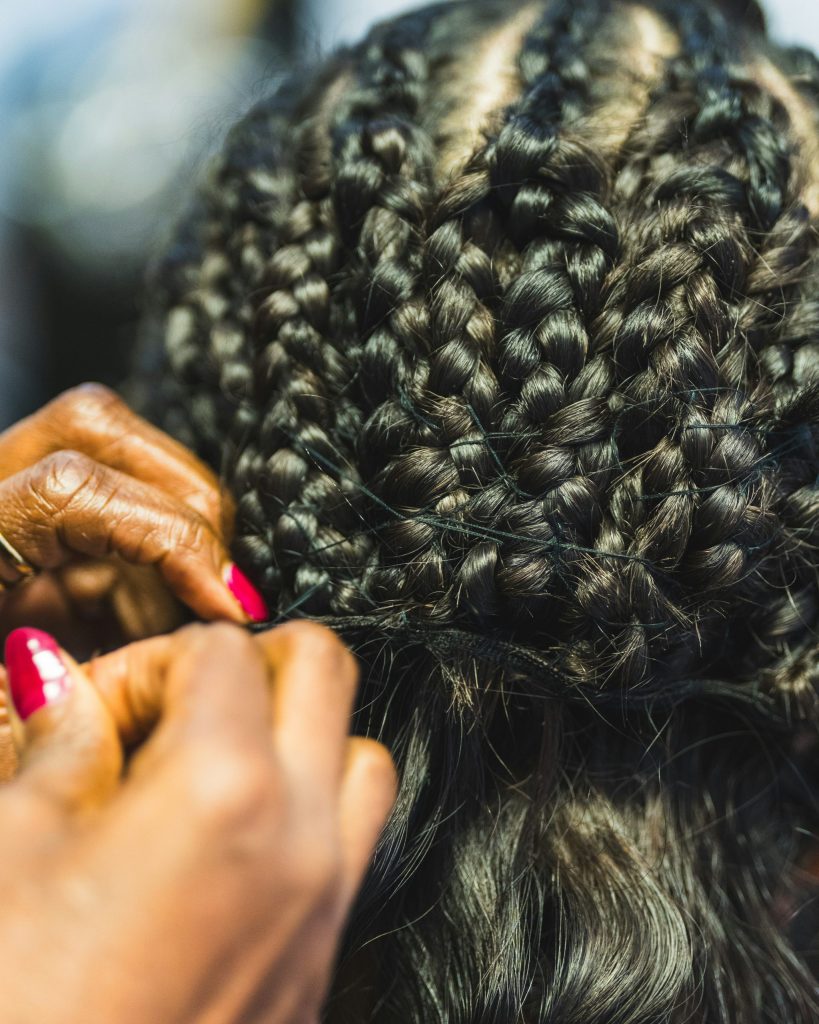
Braids, twists, wigs, and extensions have become our routine. Research indicates that most Black women who wear extensions do so on a regular basis, and these styles are typically maintained for weeks. This means that we are not just using a product; rather, we are living in it.
Besides, the beauty industry has always been very loosely regulated, particularly the products that are aimed at Black women. Many of these hair extensions don’t even list the ingredients, they aren’t tested for long-term safety, and they are made with affordability in mind rather than health. So, to be honest, the problem is not only toxicity but also the lack of transparency.
What are these chemicals actually doing?
Let’s break it down in a way that feels real, not clinical.
Your scalp knows first
If you’ve ever had a hair extension installed or braided your hair and felt itching, burning, tiny bumps, or soreness, that’s not “just sensitivity.” That can be your scalp reacting to chemical coatings or fibers.
The Harvard T.H. Chan School of Public Health stated in a March 2025 publication that these reactions are commonly linked to synthetic fibers and chemical finishes used to make hair look silky and “natural.”
Your hormones may be affected
Some chemicals like phthalates and organotins found in hair extensions are endocrine disruptors.
That means they can interfere with menstrual cycles, fertility, weight regulation, and metabolic health.
And the scary part is that these effects don’t always show up immediately.
Long-term risks are still unfolding
Researchers are linking certain chemicals in hair extensions to breast and uterine cancer, respiratory issues, and neurological effects.
And while more long-term studies are still needed, one thing is clear—repeated, prolonged exposure is a determinant.
See Also: Your Absolute Checklist Before Getting a Hair Dye
How To Make Hair Extensions Less Toxic
This isn’t about fear—it’s about control. You don’t have to give up your styles. You just need to be more intentional.
Let go of the “cheap” mindset
Synthetic hair is popular because it’s affordable. However, it is more likely to contain vinyl chloride, acrylonitrile, and chemical coatings. To reduce your exposure to such toxins, try higher-quality synthetic brands with transparency, plant-based options, or reusable human hair.
Wash your extensions before installation
There is something called the apple cider vinegar rinse. It can reduce surface residue, soften the hair and lower irritation.
But the truth is that it does NOT remove all toxic chemicals. It only reduces exposure but doesn’t eliminate it.
Shorten your wear time
If extensions are typically worn for 6 weeks, try 3–4 weeks instead. You should also give your scalp breaks between installs because exposure is cumulative.
Protect your scalp
Your scalp is skin, and it absorbs.
Try applying lightweight scalp oils as a barrier, and avoid tight installs because they increase irritation and absorption. Wash your scalp regularly even when on braids.
Be mindful of heat
Heating synthetic hair with hot water sealing or flat irons can release additional chemical fumes. Try to limit heat styling and care for your hair properly.
Start Asking The Right Questions
This is where the shift really begins.
Ask your stylist the brand of hair extensions being used and what it is made of. We need to start choosing brands that disclose materials used, market themselves as non-toxic or low-toxin, and are backed by testing.
For decades, Black women have been navigating a beauty industry that takes advantage of our needs, minimizes research on our risks, and hardly ever prioritizes our safety.
Relaxer products raised many health concerns, so hair extension was considered a safer option. You don’t have to give up braids, wigs, or extensions. This is not to say that one should be scared; it’s simply a matter of being better informed about your choices.
This means that when you have options, you choose a better one whenever it is possible. Because your beauty regimen should protect not just your hair but the whole of you.