I have been natural for over ten years, and if there is one thing I can confidently say, it is that natural hair requires intentional care and consistency. While the journey can be rewarding, it also comes with its own learning curve, and understanding your hair’s needs becomes essential over time. One of the most important, and often most challenging parts of my routine is detangling, which I have learned is not just a step, but a critical foundation for maintaining healthy natural hair.
Detangling natural hair is a technical process that requires patience and skill. For many, this process can feel like a gruelling chore or a source of frustration that often ends with yanking and pulling your hair. This often leads to breakage and hair loss. However, to truly protect the integrity of your hair, detangling must be treated as a gentle, manageable maintenance process.
SEE ALSO: Why Hair Falls Out When Relaxing Tinted Natural Hair.
Detangling does not have to feel like a battle. With the right method, the right products, and a little patience, it can become one of the most calming parts of your hair care routine. Natural hair responds to moisture, gentleness, and consistency far better than force. Once you understand that, everything begins to change.
This guide provides a clear, simple step-by-step approach to detangling your hair the right way, reducing the struggle through wash day. It explains how prioritizing deep hydration, understanding your hair type, porosity, and density, greatly transforms your hair care routine.
SEE ALSO: 7 Natural Herbs For Quick and Shocking Hair Growth
Moisture and Elasticity: The Foundation for Safe Detangling
Maintaining a balance between moisture and elasticity for your hair is very important as these two factors determine how your natural hair responds to detangling.
Moisture is the water content inside the hair strand. It softens and hydrates the hair, making it flexible and easier to manipulate. Without moisture, hair becomes dry, rough, and prone to friction, which leads to knots and tangles.
Elasticity is the ability of your hair to stretch and return to its original shape without breaking. Hair with good elasticity can bend and stretch under gentle tension, while hair with poor elasticity snaps easily when pulled.
Ultimately, there is a connection between moisture and elasticity as one directly influences the other: well-moisturized hair stretches safely, while dry hair snaps with the slightest tension.
Physically, this is reflected in the hair’s structure. The cuticle, or outer layer, is made of tiny overlapping scales. When hair is dry, the scales lift, and strands become rough, causing them to rub on each other and create tangles. The cortex, the dense inner core of the strand, contains proteins that give hair strength and shape. When hair lacks moisture, these protein bonds are rigid, and the strand has very little elasticity. Pulling on dry hair forces the strand beyond its limits, resulting in breakage.
Never Detangle Dry Hair
Hydration is key for detangling natural hair. Your hair needs to be soft and pliable, adding water and conditioner ensure this. Water enters the cortex, loosening protein bonds and softening the hair, while conditioner smoothens the cuticle and reduces friction. Moisturized hair with restored elasticity can stretch safely, and detangling becomes a controlled, gentle process that protects the hair’s integrity.
The best time to detangle is when your hair is wet or at least very damp. A good leave-in conditioner or water-based moisturizer is essential for this step. This helps to soften strands, ensure hair flexibility and reduce scalp stress. So, before you start your detangling process, take a strand of your hair and stretch it across two fingers. If it bounces back, your hair is hydrated, and you can proceed with the detangling, but if it snaps or breaks, pause and ensure your hair is well saturated with water and moisturized with conditioner.
Section your Hair Properly
Don’t try to detangle your entire head at once. That’s how you end up frustrated, sweaty, and ready for ‘the big chop’ the very next day. Sectioning allows you to focus on small areas at a time and ensures even distribution of hair products. The number of sections depends largely on your hair density: how thick your hair is.
Divide your hair into four, six, or even eight parts, depending on your hair density. Have your spray bottle to keep your hair hydrated during the process. Use clips to hold up the parts you’re not working on. This way, you’re only focusing on one manageable piece at a time, and not losing your mind.
Choose the Right Slip Ingredient
To achieve the necessary flexibility and movement needed for proper detangling, the hair requires specific ingredients that provide “slip.”Slip is what allows strands to glide past each other during detangling without creating friction or breakage. Choosing the right slip is essential for safe, effective detangling. Look for ingredients that provide both moisture and lubrication. Common effective options include aloe vera, marshmallow root, slippery elm, glycerin and behentrimonium methosulfate (a mild conditioning agent derived from rapeseed oil).
Leave-in conditioners, detangling sprays, or water-based moisturizers with these ingredients are ideal. They help hydrate, coat the hair shaft, soften the cuticle, and reduce friction between strands, making knots easier to loosen. Thoroughly apply an adequate amount of slip to each section as you begin detangling.
Use your Fingers Before any Tools
Finger detangling first, before any tools, reduces breakage significantly. Your fingertips are sensitive sensors; they can feel a micro knot that a comb will simply rip through. Spend five to ten minutes, just separating strands with your fingers to get the big knots loosened.
Always start detangling at the ends of your hair. Not the roots. Not the middle. The ends. They are more fragile and prone to tangles, so be gentle. Before the slip, the ends are usually dry and tend to have more tangles. This is because they are not close enough to the scalp’s natural lubricating oils. Work through the ends with your fingers, gently loosen knots and undo tangles. Once the ends are knot-free, move up to the mid-lengths with the same gentle approach. Then move to the roots. The roots are usually easier because they’re connected to the scalp and have more natural oils, so you have done the hard work by the time you get there.
SEE ALSO: Self-Care Without Hair Care to Me Doesn’t Make Sense.
Use a Wide-tooth Comb, not a Fine Comb
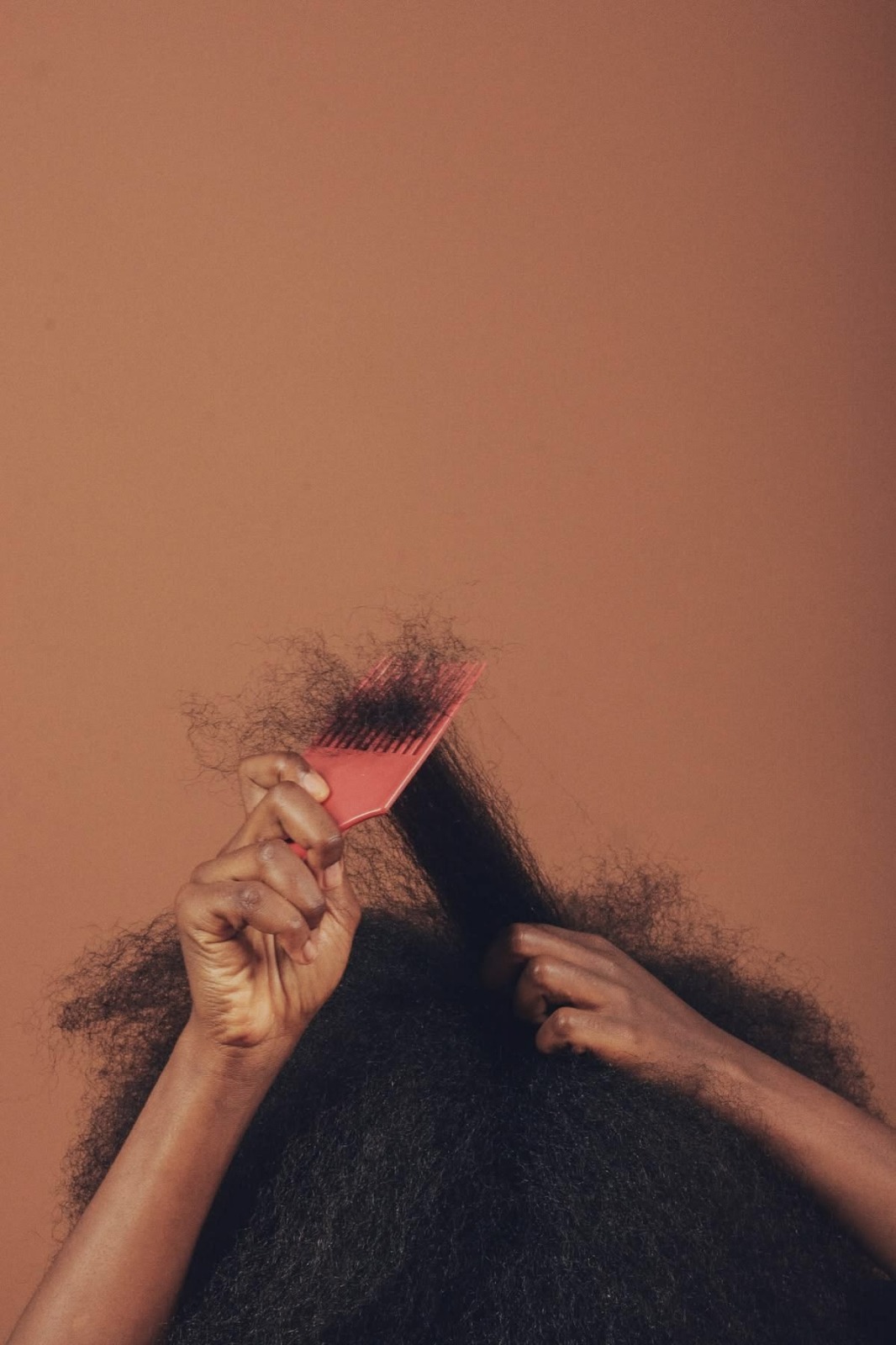
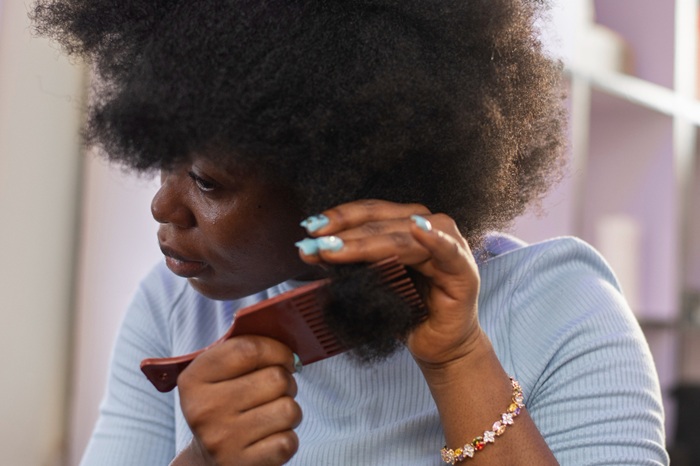
Fine-tooth combs, dense brushes, or damaged tools with rough seams can snag the hair and lift the cuticle. Choose a comb made of smooth, durable material such as high-quality plastic, acetate, or wood to prevent snagging. Avoid metal combs with rough edges or fine teeth, as they increase friction and the risk of breakage.
Using a wide-tooth comb correctly ensures a smooth glide through hair that has been properly hydrated and finger-detangled. It completes the detangling process efficiently while maintaining hair integrity. The wide spacing between teeth minimizes tension on individual hairs, reducing breakage compared to fine-tooth combs or brushes.
Just like using your fingers, when using a comb, always start at the ends of the hair and work your way up toward the roots. You are looking for a smooth, effortless glide, and if you hit resistance, add more conditioner or slip and use your fingers for a moment. Even the right tool, when forced through resistant sections, becomes harmful.
Protect the Work as You Go
As soon as a section is smooth and your comb glides through from root to tip, twist or braid it up immediately. Do not let it just hang there. If it dries or rubs against your clothes while you work on the sections, it will re-tangle, and you’ll find yourself right back at the start point.
If you’ve got thick, dense hair, this could take an hour or more. That’s fine. At least you are not yanking or pulling anything. The ultimate goal is to be done and still have most of your hair attached to your head.
Porosity and Product Layering: LOC vs LCO
After your hair is fully detangled, you need to retain and seal in all that moisture. It keeps your hair soft and manageable all week. This is where the “Layering Rule” comes into play: the well-known LOC or LCO sequence method.
The L stands for liquid, usually water or a leave-in conditioner, which hydrates the hair. The O represents oil, used to seal that moisture into the strand. Finally, the C stands for cream, which enhances softness and helps lock everything in place.
To achieve the best results, you need to match the method to your hair’s unique type, particularly its porosity. Some of us have the 3B hair with loose, springy curls. Others have 4C hair that’s tightly coiled with densely textured strands. And then there’s everything in between.
Understanding your hair type also means knowing your hair porosity, which is how well your hair absorbs and retains moisture.
Medium-porosity hair has the most flexibility with perfectly spaced cuticles to retain just enough moisture. A balanced routine can be maintained using milk-based and cream-based products.
The hair porosity test is initiated by placing a few strands of clean, dry hair in a glass of room-temperature. Observe them for three to four minutes. If the hair floats on the surface, the cuticles are tightly closed and resisting the water, which signals low-porosity hair. Low-porosity hair can be stubborn about accepting moisture, so you need warm water and lightweight, water-based products that can penetrate through the cuticle.
If the hair sinks quickly to the bottom, it is high-porosity hair. The cuticles have gaps or are raised, allowing the strand to become saturated and heavy almost instantly. High-porosity hair absorbs moisture but loses it quickly, so you need heavier sealants, such as butters and oils, to block the large holes in its cuticle and keep that hydration locked in.
Medium-porosity hair has the greatest flexibility with evenly spaced cuticles that retain just enough moisture, allowing it to float in the middle of the glass. It features a balanced structure that absorbs water at a steady, healthy rate. A consistent routine can be maintained using milk-based and cream-based products.
If you have high-porosity hair, the LOC method is often your best choice: liquid, then a rich oil, followed by a heavy cream, ensures moisture and volume retention.
On the flip side, the LCO method works better for low-porosity hair. Apply your liquid first, followed by a penetrating cream, and finish with a lightweight oil that seals everything in without weighing your strands down.
Proper layering supports moisture retention, which preserves elasticity. When moisture is maintained, detangling becomes easier over time because hair remains flexible and less prone to severe tangling.
Protect the Fragile Areas: Ends and Edges
The ends and edges of your hair are the most fragile areas and require extra care during detangling. When you’re detangling, be gentle around your hairline. You don’t want to pull hair around your edges in the name of detangling. Your edges are delicate, and they deserve care, and so do your ends. The ends are the oldest part of the strand. They have been exposed to the most manipulation, weather, friction, and styling. Over time, the cuticle naturally wears down, leaving the cortex more vulnerable to splitting and breakage. Avoid dragging tools repeatedly through these areas.
Maintaining Detangled Hair
Allowing shed hairs to accumulate for extended periods increases the likelihood of tangles. Each day, the scalp naturally sheds strands. If these are not removed regularly, they wrap around neighboring hairs and form knots over time.
You don’t have to wait till your hair is all tangled or full of knots before you detangle. Whether it’s once or twice a week, detangling your natural hair should be a regular and intentional part of your hair care routine. Maintaining consistency in regular hair care keeps your strands softer, more manageable, and less prone to tangles.
Putting your hair in simple twists, braids, or even a low bun can minimize friction, reduce re-tangling, and maintain moisture for longer. Protective styling helps reduce daily manipulation and, more importantly, the chance of those knots sneaking back in, keeping your hair detangled and stretched until your next wash day.
Sleeping with a satin or silk bonnet or pillowcase also minimizes surface friction that contributes to tangling.
You don’t have to wait till your hair is all tangled or full of knots before you detangle. Whether it’s once or twice a week, detangling your natural hair should be a regular and intentional part of your hair care routine. Maintaining consistency in regular hair care keeps your strands softer, more manageable, and less prone to tangles.
Putting your hair in simple twists, braids, or even a low bun can minimize friction, reduce re-tangling, and maintain moisture for longer. Protective styling helps reduce daily manipulation and, more importantly, the chance of those knots sneaking back in, keeping your hair detangled and stretched until your next wash day.
Sleeping with a satin or silk bonnet or pillowcase also minimizes surface friction that contributes to tangling.
When detangling becomes a regular part of your routine rather than a corrective measure, breakage decreases, and manageability improves significantly. Consistent maintenance between wash days prevents minor tangles from becoming severe knots. When shed hair is removed regularly, friction is minimized, and strands are protected from unnecessary stress, making detangling easier over time.