
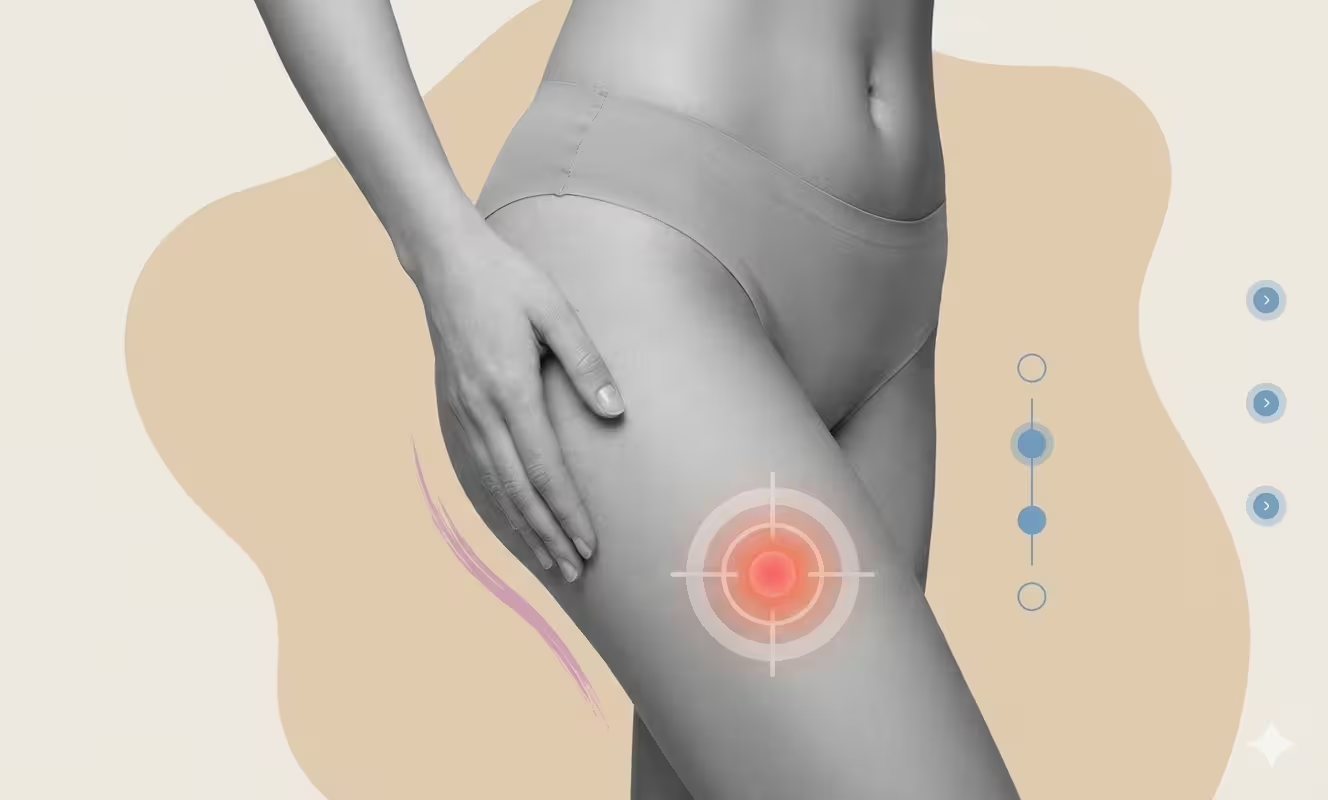
Rhoda is a brand consultant in Victoria Island, Lagos, a successful professional whose career, theoretically at least, has very little to do with the shape of her body. Still, the idea of a Brazilian Butt Lift has crossed her mind more than once. “I scroll through Instagram,” she says, “and it feels like everyone — influencers, celebs, even my colleagues has gone under the knife”. She futher adds that they even document their BBL journey: from pre-op nerves to recovery, sitting struggles, and finally that first outfit reveal. It doesn’t feel like vanity. A part of her thinks the results come with more than just beauty, but power as well.
Today, with confidence and presentation intertwining with social and professional life, the BBL trend has taken on its own cultural rhythm. “It’s not that I hate my body,” she says. “It’s more that I know how much easier things seem for women who fit a certain look.”
Brazilian Butt Lifts , a cosmetic surgery that transfers fat from other parts of the body to enhance the hips and buttocks, have become one of the most talked-about body contouring procedures in recent years. In Nigeria, demand for these surgeries has exploded. Globally, estimates suggest that more than 600,000 BBLs were performed worldwide in 2024, with demand up more than 4,000 % over the past decade.
In urban centers like Lagos, the BBL trend has local texture. Influencers and celebrities openly share snippets of consultations, surgical moments, and “recovery moments”. They talk about the foam pillows used to keep weight off the incisions, the choice of body shapers they use post-op, and the first time they sit without discomfort. This documentation makes the procedure feel both normalized and accessible. But visibility does not necessarily equate to safety or suitability.
SEE ALSO: Self-Love: Building Body Confidence Without Self-Denial
Part of the BBL’s appeal is cultural. In many parts of the world, curvier silhouettes have been celebrated for generations. In Nigeria for instance, traditional aesthetics often valorize fullness and roundness, but the modern interpretation, shaped by global media, can feel like a new benchmark. A study on cosmetic surgical trends in Nigeria suggests that women seek body modification not just for aesthetic reasons but due to perceived social and courtship advantages, even as these choices influence men’s perceptions of female bodies.
Rhoda reflects this tension. “I know I’m successful,” she says. “But there’s a part of me that wonders whether walking into a room with a different silhouette might change how I’m seen — not just on Instagram, but in boardrooms, events, even social gatherings.”
It’s this intersection of social perception and individual agency that makes the decision so fraught. The question isn’t just “Does it look good?” but “Does it change how the world interacts with you — and should it have to?”
The BBL is more than liposuction or simple augmentation: it’s a complex surgical process that depends heavily on anatomical precision. A large analysis of over 3,000 patients found that the procedure can yield high satisfaction, about 86 % of patients reported they were pleased with their results, and around 70 % of the transferred fat tended to survive long-term. Yet, satisfaction statistics only tell part of the story. Another research underscores the serious risks associated with the procedure. It has been identified as the cosmetic surgery with the highest mortality rate compared with other aesthetic surgeries like liposuction or breast augmentation. This is largely due to the risk of fat embolism, a condition where injected fat enters the bloodstream and travels to the lungs or heart, potentially proving fatal if not immediately treated. Much of the danger stems from surgeries performed by under-qualified practitioners or in unregulated settings.
This procedure is neither uniformly dangerous nor universally safe. Its outcome hinges on context, on who performs it, where it is performed, and how carefully the patient is assessed beforehand.
Anyone seriously considering a BBL should understand that the surgery’s effects are not instant, and the process is more involved than most viral videos suggest. After the fat transfer, patients typically face weeks of restricted seating, swelling, and careful positioning to ensure the fat grafts survive. Full recovery often takes two to three months, during which patients may need to sleep on their stomachs or use specialised cushions that keep pressure off the buttocks.
Rhoda’s friends who have undergone the procedure speak of it in both pragmatic and emotional terms. “The first two weeks were the hardest,” one acquaintance told her. “You can’t sit normally, you sleep funny, and there’s this constant fear of losing the shape you paid for.” Others have described the sense of psychological uplift — a boost in confidence that extends beyond physical form, alongside genuine fatigue from the recovery regimen.
But experts caution that psychological readiness matters. Studies show that education about the risks of BBL significantly changes many women’s willingness to undergo the surgery. In one survey, around 70 % of participants who were initially considering BBL chose not to proceed after learning more about the risks.
So back to the main question. Is a BBL worth it, and for whom? Is It Worth It — And For Whom?
The short answer is: It depends.
For some women, a well-executed BBL can feel transformational, not merely cosmetic but deeply connected to how they carry confidence and presence. For others, the risks, recovery, and cultural pressure make the investment less compelling, especially when weighed against long-term health and psychological wellbeing.